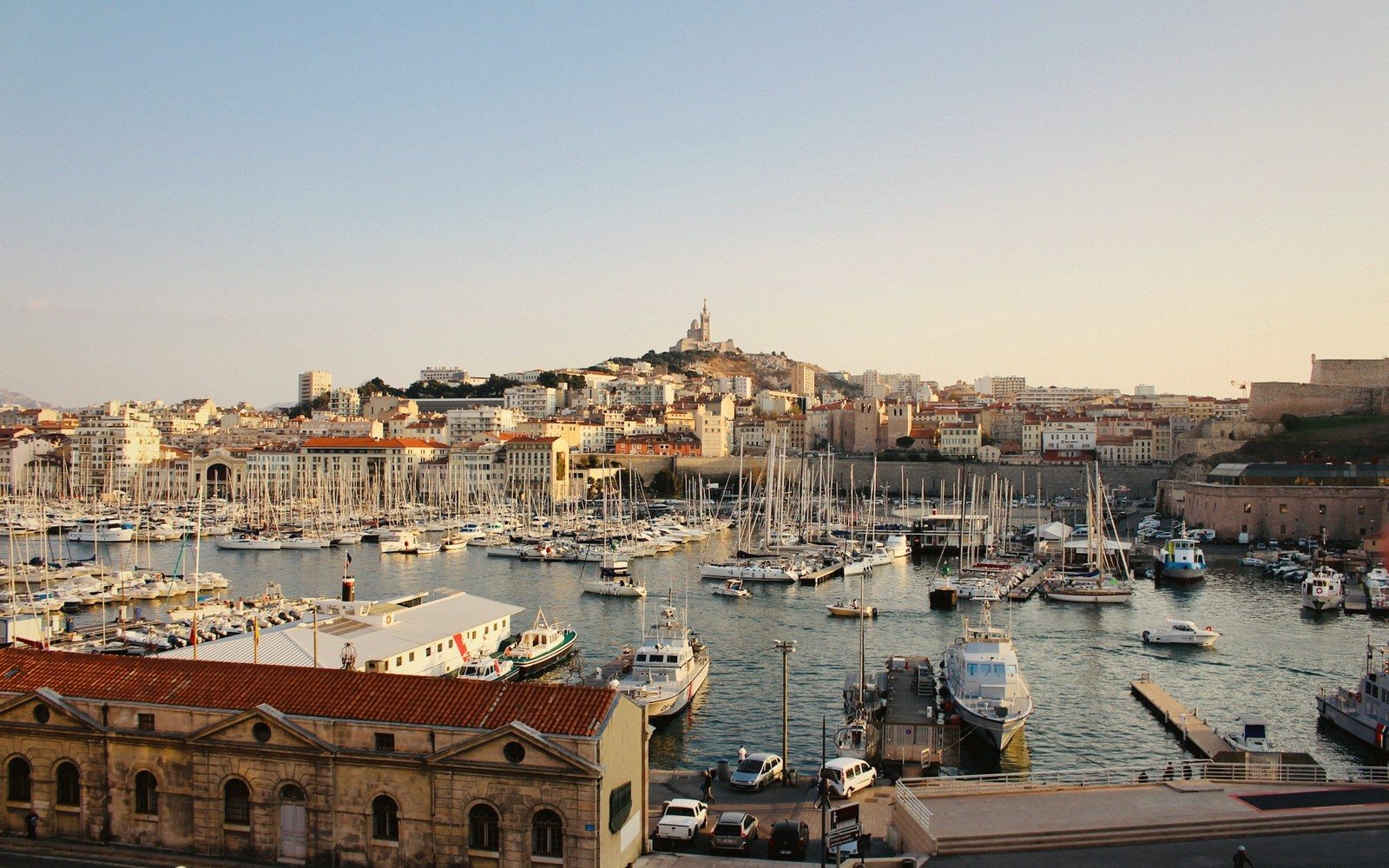
The City That Doesn't Perform for You
Marseille is not trying to win you over. That's the first thing to understand, and also the thing that makes it worth going. Paris performs; Lyon charms; Marseille simply exists — loudly, saltily, on its own terms — and you either fall for it or you don't. Most people who give it a real chance fall hard.
It is France's oldest city, founded by Greek sailors around 600 BCE, and it has had 2,600 years to develop a personality. That personality is: direct, market-oriented, proud, a little chaotic, deeply Méditerranéen, and profoundly unimpressed by its own reputation. The Vieux-Port has been a working harbour for all of those centuries. It still smells like one. That's the point.
Arrive and resist the urge to open a list. Walk to the Vieux-Port first — not to see it, exactly, but to get your bearings in it. The morning fish market sets up at the port's northern edge and sells directly off the boats: sea urchins in styrofoam trays, rascasse, Saint-Pierre, the particular small rockfish that make a real bouillabaisse possible. Buy nothing if you like. Just watch, and you'll know exactly where you are.
How to Eat Here
Bouillabaisse is the obvious starting point and also a potential trap. The tourist-grade version, served in the wrong part of the port, is expensive and forgettable. The real thing — a two-course ritual of saffron-steeped broth ladled first, then the fish — takes a little more effort to find and rewards it. A handful of serious restaurants in the city still prepare it properly, serve the rouille separately on croutons, and charge accordingly: expect to pay for it, because the fish are expensive and the labour is real. It is worth doing once, properly, rather than cheaply twice.
But Marseille's daily eating is not bouillabaisse. It is navettes from the Four des Navettes, the oldest bakery in the city — orange-flower-scented boat-shaped biscuits that date back to the 1780s. It is a panisse (a fried chickpea-flour cake, street-level, salty, ordered at a counter) eaten standing up in the Noailles quarter, where the market stalls spill out in every direction and the air smells of cumin and citrus and diesel. It is a glass of rosé from the Provence hinterland at a table that is too small, with bread you didn't order and olives you didn't either.
Noailles, the neighbourhood just east of the Canebière — Marseille's long central boulevard — is where the city does its real shopping and feeding. It is messy and alive and the best place to eat for under fifteen euros in this city. Go there before anywhere else.
Noailles, the neighbourhood just east of the Canebière — Marseille's long central boulevard — is where the city does its real shopping and feeding.
The Water
What redeems all the roughness, and what Marseille holds over every other large French city, is the calanques: the chain of white limestone inlets that begin almost within the city limits and run east along the coast for some twenty kilometres toward Cassis. The Calanques National Park — a rare urban national park, created in 2012 — protects this coastline, and the light it produces in the afternoon, bouncing off pale rock into turquoise water, is simply not something the north of France can offer you.
Getting there without a car means a bus to the trailhead at La Madrague de Montredon or Callelongue and then walking. Calanque de Sormiou and Calanque de Morgiou are the closest and reward the effort quickly. In high summer, access to some inlets is restricted when fire risk is high — check the national park website before you go, because they do enforce it. Arrive early, bring water, wear shoes that grip rock.
If the calanques feel too far on a given day, the neighbourhood of L'Estaque to the north — an old fishing village absorbed by the city — has a particular quality of light that attracted Cézanne and then the Cubists in the early twentieth century. Braque painted there. The quays are unglamorous now, but the light hasn't changed, and a coffee at the port watching the tankers out on the Golfe de Fos costs almost nothing and is very good for the disposition.
The Actual Rhythm
Marseille rewards slowness more than sightseeing. The Basilique Notre-Dame de la Garde, sitting high on its hill south of the Vieux-Port, is genuinely worth the climb — less for the neo-Byzantine interior than for the panorama, which takes in the islands, the calanques' first headlands, and the full sweep of the city's unlikely geography. Go late afternoon when the light is golden and the tour buses have gone.
Le Panier, the old quarter climbing the hill north of the Vieux-Port, is tourist-worn but still has good bones: steep streets, laundry between windows, a few ceramics ateliers and independent bookshops that feel genuinely inhabited. It is best experienced early, before it fills.
The rule of thumb for Paris, by mood — pick a feeling, not a landmark — applies even more to Marseille. The city is too mercurial for a checklist. Some days it gives you everything; some days it keeps you at arm's length. Let it. Come back the second day with no plan, follow the smell of the sea, and buy something from the market you don't entirely know how to cook. That's the visit.